

 Blog
Foreign investors can generally establish and fully own a Turkish company without a Turkish shareholder. The right structure depends on the business activity, the relationship between the founders and whether the investor will work in Turkey. Registration creates the company; it does not automatically provide banking access, an operating licence or a work permit.
A useful formation plan therefore looks beyond obtaining a registration certificate. It connects ownership, management powers, funding and the company's first transactions. For businesses registered in 2026, it must also address the new electronic company-book requirements from the start.
Contents
1. Can a Foreigner Own a Company in Turkey?
Yes. Turkey's foreign-investment framework generally gives international investors the same rights and obligations as domestic investors. A Turkish partner is not a general requirement for an ordinary commercial company. Certain regulated activities have additional ownership, permission or licensing rules, so the intended business must be identified before choosing the structure.
A local subsidiary, a branch of an overseas business and a liaison office serve different purposes. A liaison office is not a substitute for a company that will trade and invoice customers. The Investment Office's establishment guidance explains these routes and the registration framework.
The practical starting point is the activity: who will sell the product, employ staff, sign leases and receive customer payments? For example, a foreign manufacturer opening a sales operation has different needs from two founders building a business they intend to sell. Choosing the cheapest formation package before answering these questions can leave important decisions unresolved.
2. Limited Company or Joint-Stock Company?
A limited company, known as a limited sirket or Ltd. Sti., and a joint-stock company, known as an anonim sirket or A.S., are common options. Both can have one shareholder. The Ministry of Trade's company guidance gives the ordinary minimum capital as TRY 50,000 for a limited company and TRY 250,000 for a joint-stock company. Special regimes may require more.
| Decision point | Limited company | Joint-stock company |
|---|---|---|
| Ordinary minimum capital | TRY 50,000 | TRY 250,000 |
| Management | Manager or managers | Board of directors |
| Ownership planning | Consider for a relatively stable shareholder group. | Consider where investment rounds or future share transfers are important. |
| Before choosing | Review manager powers, partner obligations and exit terms. | Review board control, investor rights and the proposed capital structure. |
The capital figures concern ordinary company formation. Regulated activities and work-permit applications can have different requirements.
The comparison is not simply small business versus large business. A limited company may suit a stable ownership group, while an A.S. may be considered where investment rounds or changes in ownership are central to the plan. Neither structure removes the need to examine management responsibility, public debts, personal guarantees and the founders' obligations.
Where there is more than one investor, the formation documents should address disagreement as well as cooperation. A 50/50 ownership split without a workable decision process can make the company difficult to operate. Voting arrangements, funding obligations and an agreed exit process deserve attention before the first commercial commitment.
3. Capital, Funding and Who Can Bind the Company
For ordinary cash contributions, at least one quarter of an A.S. company's subscribed capital is paid before registration, with the remainder due within 24 months. A limited company's cash capital can be paid within 24 months after registration. These statutory payment rules should not be confused with the money needed to operate the business.
A company may need funds for rent, salaries, equipment and customer orders long before those deadlines. The founders should decide which transfers are capital and which are shareholder funding. An unexplained transfer from a related overseas business can create accounting and banking questions later. Funding arrangements should therefore be documented with the accountant's input.
The articles and representation arrangements should also reflect how the business will be run. Who may sign a lease, borrow money or commit to a large supply contract? If joint signatures are intended, the arrangement needs proper legal implementation. A private understanding between shareholders should not be assumed to restrict every transaction a registered representative makes with third parties.
4. Foreign Documents and Formation by Power of Attorney
An individual shareholder and an overseas corporate shareholder require different documents. An individual file centres on identity and representation. A corporate shareholder must also demonstrate its legal existence, the decision to invest and the authority of the person acting for it. Foreign documents may require apostille or other legalisation and Turkish translation, depending on their origin.
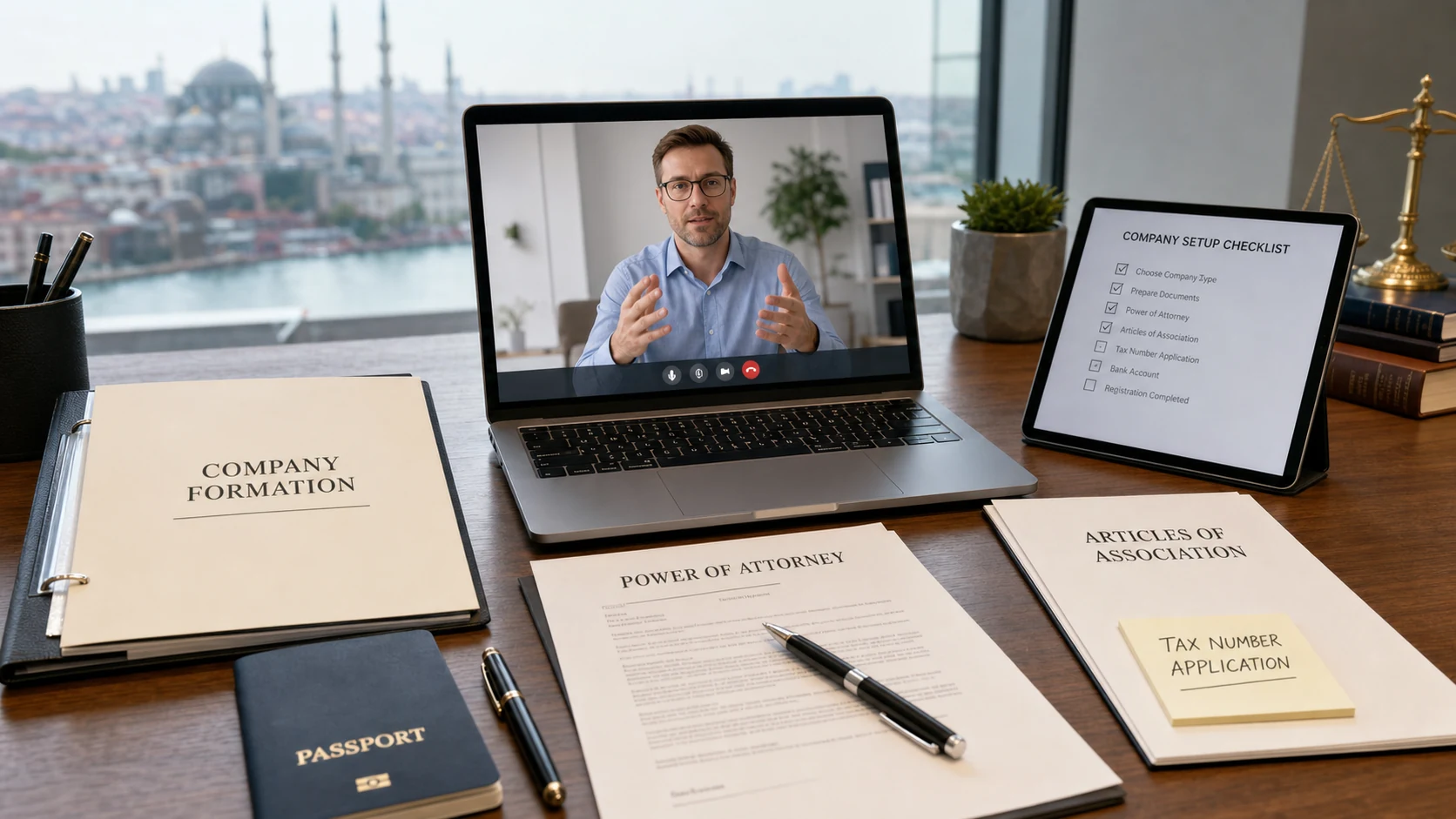
Much of the establishment work can be handled through a properly prepared power of attorney. Its wording should fit the selected structure and the acts the representative must perform. Preparing the document after the registry application has already been drafted can lead to avoidable revisions or another appointment abroad.
Remote incorporation does not mean every later step can be completed remotely. A bank may want to identify the shareholder or authorised signatory through its own process. Where the investor plans a short visit, the formation documents, bank arrangements and any personal appointment requirements should be coordinated before travel is booked.

5. Registration, Business Address and Permission to Operate
Company establishment uses MERSIS, the central registry system, together with the relevant trade registry. The articles, founders' documents and representation arrangements must support the same application. A draft entered in MERSIS is not itself proof that the company has been registered or that every activity in its proposed business description is authorised.
The registered address should be chosen for the actual business. A serviced office may be suitable for some activities but cannot be assumed suitable for a shop, workshop or activity requiring specific premises. The lease, use of the premises, official correspondence and any operating permissions need to be considered together.
Before agreeing a long lease, it is sensible to separate formation from permission to operate. A company can exist while still lacking a sector-specific approval or workplace licence. The same distinction matters when buying an existing company: its registration history is not evidence that all its present activities are compliant.
Planning a Turkish Business?
The intended activity and ownership structure determine more than the registration documents. Legal Istanbul can assess the formation and representation arrangements before you commit to premises or funding.
The address, tax office and registration stage is where many avoidable problems start; see common legal mistakes when opening a company in Turkey.
6. Electronic Company Books and Ongoing Administration
A relevant change applies to companies registered from 1 January 2026. The Ministry of Trade's ETDS notice requires their share ledger and general assembly meeting and deliberation book to be kept electronically. These books open through the system at registration. Electronic maintenance of the board decision book remains optional under that notice.
ETDS concerns company records, not a replacement for tax accounting. The person responsible for recording shareholder decisions should be identified alongside the accountant responsible for financial records and declarations. Automatic opening of a book does not ensure that later decisions are properly recorded or that the company's separate reporting duties are fulfilled.
A foreign-owned company also needs a workable arrangement for tax registration, invoices, payroll where relevant and applicable foreign-investment reporting. The scope should be agreed with the accountant rather than assumed to be included in a one-off incorporation fee. When the owners live abroad, responsibility for receiving official notices deserves particular attention.
The first contracts matter too. Customer terms, employment agreements, supplier arrangements and ownership of the business name should fit the new entity. A trade name registered at incorporation should not be treated as a substitute for a separate assessment of trademark protection.
7. Banking and the Foreign Owner's Right to Work
Corporate bank-account opening is a separate review. The bank may examine the ownership chain, people who ultimately own or control the company, proposed activity and source of funds. Registration documents are part of that review, not a promise of approval. The intended countries, currencies and payment volumes should be discussed before the business commits to a payment deadline.
A newly formed company should be able to explain its first transactions. For example, a shareholder's funding transfer and a customer's advance payment have different purposes and should not be described interchangeably. Our bank-account opening guide explains the distinction between preparing an application and obtaining banking approval.
Owning shares does not automatically authorise work in Turkey. The owner's management role, residence and any applicable exemption must be assessed. The Ministry of Labour's current work-permit criteria also contain separate capital and employment tests for foreign company partners. A company formed with the ordinary minimum capital should not be assumed to meet those tests.
Where the investor intends to manage the business personally in Turkey, that assessment belongs in the formation plan. It may affect the funding, staffing and timing of the project. Equally, a passive overseas shareholder should not be given the same advice as a shareholder who will work at the company's premises every day.
8. Planning the Establishment and First Transactions
The most useful formation advice identifies what must be ready before the company begins trading. Registration, bank onboarding, premises permissions and the investor's immigration position should have separate responsibilities and realistic timing. A promise that one registration certificate resolves all four is a reason to examine the proposed service more closely.
Costs should distinguish public charges and document expenses from legal work, accounting and recurring operating costs. The capital contribution is a company funding obligation, not simply a government formation fee. A clear scope also explains whether later shareholder resolutions, banking assistance or licence work are included.
Legal Istanbul can assist with the choice of structure, formation documents, shareholder arrangements and representation powers, coordinating with the accountant and relevant professionals where needed. A useful initial discussion starts with the intended activity, proposed owners and whether anyone will relocate to Turkey. That is more informative than choosing a company type from its minimum capital alone.
Consult Legal Istanbul
Discuss Your Company Formation in Turkey
Contact our law firm for legal support with your matter.
Please do not share passwords or sensitive documents.
Legal references: Investment Office: establishing a business; Ministry of Trade: company types and capital; Ministry of Trade: ETDS requirements from 1 January 2026; Ministry of Labour: work-permit assessment criteria; Ministry of Labour: foreign shareholders and managers. This article provides general information. Advice depends on the applicable rules and your circumstances.
9. FAQ
Can a foreigner own 100% of a Turkish company?
Generally, yes. A Turkish shareholder is not a standard requirement for an ordinary commercial company. Regulated activities may have additional restrictions, so the proposed business should be checked before registration.
How much capital is needed to open a company in Turkey?
The ordinary minimum is TRY 50,000 for a limited company and TRY 250,000 for a joint-stock company. Operating funds and any sector-specific or work-permit requirements must be considered separately.
Can I establish a Turkish company without travelling to Turkey?
Many formation steps can be handled through a properly prepared power of attorney. That does not guarantee remote completion of bank identification, immigration appointments or every later business procedure.
Does opening a company give me a work permit?
No. Share ownership and permission to work are separate issues. Your role in the company, residence and any applicable exemption must be assessed, together with the relevant work-permit criteria.
Can a Turkish company use a virtual office?
A serviced or virtual office may be appropriate for some businesses. Suitability depends on the actual activity, address arrangements and any premises or licensing requirements; it should not be assumed for every company.
Which electronic company books are required for a company formed in 2026?
Companies registered from 1 January 2026 must keep their share ledger and general assembly meeting and deliberation book in ETDS. This is distinct from tax accounting and does not make every company book electronically mandatory.
Is a corporate bank account guaranteed after registration?
No. Banks conduct their own review of ownership, representatives, business activity and funds. Incorporation documents support an application but do not oblige a bank to accept it.
How long does company formation in Turkey take?
Timing depends on the structure, foreign documents and registry requirements. Registration time should be separated from the time needed for banking, licences and permission to work. An estimate is more useful after the proposed structure and documents are reviewed.
Do I still need an accountant after the company is registered?
Ongoing accounting and applicable reporting must be arranged after formation. The accountant's scope, responsibility for official notices and responsibility for company decisions should be clear, especially when the shareholders live abroad.