
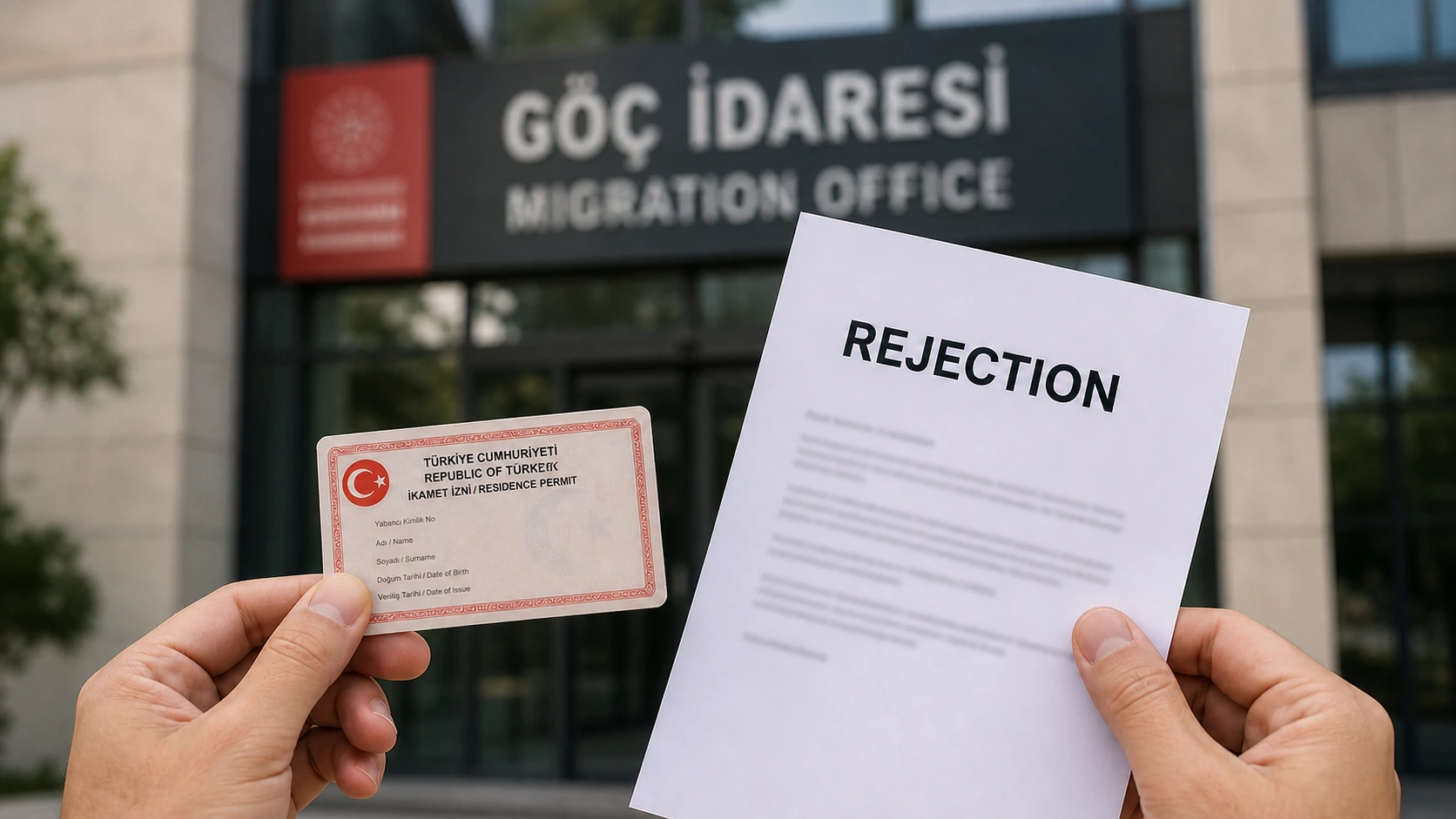
An action for annulment against a residence-permit rejection may be filed in the administrative court within 60 days from the day following notification; if the decision contains an obvious error, an administrative application may be made within the same period. Filing a case does not, by itself, grant a right to stay in Turkey; a stay-of-execution order is required. Before choosing a route, establish 4 points: the reason for rejection, the notification date, the 10-day departure period and whether there is a separate removal decision.
What Is a Residence-Permit Rejection, and on What Grounds Is It Issued?
A residence-permit rejection means that the governor’s office has refused a foreign national’s application for a permit to remain in Turkey or for an extension. For applications made within Turkey, the governor’s office—in practice, the Provincial Directorate of Migration Management—issues the decision and notifies the foreign national, their legal representative or lawyer. It is an administrative act under Law No. 6458 on Foreigners and International Protection and is subject to judicial review. It is also commonly called a “residence permission refusal”.
The grounds for rejecting a short-term residence permit are set out in the Law and Regulation:
- the purpose of the application, documents or financial resources are considered insufficient,
- accommodation meeting general health and safety standards is unavailable,
- address information is not supplied or the address does not match the record,
- a criminal-record certificate is not produced when requested,
- the person falls within the category of foreign nationals who may not enter Turkey,
- the permit is used for a purpose other than the one for which it was issued,
- a valid removal or entry-ban decision exists,
- a debt or fine arising from an overstay, previous residence or a public claim remains unpaid.
Rejection, non-extension and cancellation are related but different measures. Rejection is refusal of a new application; non-extension means an expiring permit is not continued; cancellation terminates a permit that is still valid. The measure involved directly affects the period of stay in Turkey and the next steps.
What Routes Are Available Against a Residence-Permit Rejection?
There are 2 legal routes: an application to the authority that issued the decision and an action for annulment in the administrative court. A stay of execution requested within the case and a new application for a different purpose are additional options. Their results are not equivalent.
Routes available after a residence-permit rejection (October 2026)
| Route | Where to apply | Result |
|---|---|---|
| Administrative application | The governor’s office that issued the decision or a higher authority | The administration may remove or amend the decision; if no response is given within 30 days, the request is deemed rejected |
| Action for annulment | The administrative court in the locality of the governor’s office that issued the decision | A rejection found unlawful is annulled |
| Stay of execution | The administrative court in the same case | If the conditions are met, the rejection is not implemented while the case is pending |
| New application for a different purpose | Governor’s office | A new permit may be obtained; the original rejection remains in place |
Filing a case does not, by itself, grant a right to stay in Turkey.
In practice, the choice depends on the nature of the rejection grounds. If the decision contains an obvious error—for example, a submitted document was overlooked or another person’s record was used—an administrative application may produce a result sooner. Where rejection rests on administrative discretion or an assessment, court proceedings become the stronger option.
Which Facts Matter When a Residence Permit Is Rejected?
“I have been refused a residence permit” does not, on its own, identify the right route. Of two foreign nationals making the same statement, one may obtain a result through a brief administrative application, while the other can protect their permit only through the courts. The following questions must be answered:
- what reason and legal provision the rejection relies on,
- whether the decision concerns an initial application, an extension or cancellation,
- when and how the decision was notified,
- whether the notification includes a 10-day departure period or a separate removal decision,
- whether the visa or visa-exempt period remains valid,
- whether there are ties in Turkey, such as a spouse, children or long-term residence,
- whether an unpaid fee, fine or debt is recorded.
Choosing a route without these answers can result in a missed deadline or an unnecessary second rejection. For example, where two decisions have identical grounds but one was notified 5 days ago and the other 55 days ago, there is time for an administrative application in the first case; in the second, filing a case is the only safe option.
Does an Administrative Challenge Suspend the Court-Filing Period?
An administrative application suspends the filing period only under specific conditions, and this protection is not broad enough to be relied on safely. Under the Law, before filing a case and within the filing period, the person may ask the higher authority—or, if there is none, the authority that issued the act—to remove, withdraw or amend it (Article 11 of Law No. 2577). Its effect on the filing period must be considered with the following limits:
- an application made after the 60-day period has expired does not restore a missed court deadline,
- the period does not restart; after a rejection response it resumes from where it stopped, and days elapsed before the application count,
- if the administration does not respond within 30 days, the request is deemed rejected and the remaining period continues to run,
- a new residence-permit application or a general petition may not count as a request to remove the act,
- an administrative application does not suspend the 10-day departure period or implementation of the rejection.
The safe approach is therefore to count the court-filing period from notification as though no administrative application had been made. If the error concerns a difference in assessment, filing directly in court is safer.
How Does an Action for Annulment Against a Residence-Permit Rejection Work?
An action for annulment is filed in the administrative court in the locality of the governor’s office that issued the decision. Since no special period is prescribed, the filing period is 60 days (Article 7 of Law No. 2577). The court examines whether the rejection complies with the statutory conditions, the stated reasons and the principle of proportionality. The following points carry weight:
- whether the rejection grounds rest on a concrete fact,
- whether the submitted documents were actually assessed,
- whether the basis for records such as a restriction code has been shown,
- whether the foreign national’s family ties and length of residence in Turkey were considered.
In 2024, the Law accelerated the procedure for short-term residence-permit cases: the file is considered complete when the defence is submitted or the defence period expires, and whether to hold a hearing is at the court’s discretion. The administrative court’s judgment may be appealed to the regional administrative court within 30 days of notification. Law No. 7589 was published in the Official Gazette on 31 July 2026.
Under that Law, cases arising from Law No. 6458 cannot be further appealed to the Council of State even if the regional administrative court sets aside the judgment and issues a new decision. These cases therefore generally become final at the regional administrative court.
When Does the Filing Period Begin After a Residence-Permit Rejection?
The filing period begins on the day following notification of the rejection; neither the date of the decision nor the date it appears in the system is decisive. In practice, a rejection may also be notified through the National Electronic Notification System (UETS). Under the Notification Law, electronic notification is deemed made at the end of the 5th day following arrival at the recipient’s electronic address. The arrival date in the UETS record is therefore the key information for establishing when the period begins and should be retained.
Does Filing a Case Allow You to Remain in Turkey?
No. Filing a case against a residence-permit rejection does not automatically permit continued stay in Turkey. The Law expressly provides: “Filing proceedings before the Council of State or administrative courts does not suspend execution of the administrative act challenged.” To remain lawfully while the case is pending, the foreign national needs a court order staying execution.
When Is a Stay of Execution Granted After a Residence-Permit Rejection?
A stay of execution means that the court suspends implementation of the rejection until the case is decided. It may be granted where 2 conditions are present together: the act is clearly unlawful and its implementation would cause harm that is difficult or impossible to remedy (Article 27 of Law No. 2577). A parent facing separation from family or a student whose education would be interrupted are typical examples concerning the harm condition. A decision on a stay-of-execution request may be challenged once within 7 days of notification.
The 10-day stay period continues to run until a stay-of-execution order is issued. As a rule, the court gives the order after receiving the administration’s defence, so it may not be issued within 10 days. The foreign national can then leave Turkey on time and continue the case from abroad.
Must You Leave Turkey Within 10 Days After a Residence-Permit Rejection?
As a rule, yes. A foreign national whose permit application is rejected or whose permit is not extended receives a document allowing a stay in Turkey of only up to 10 days. This must not be confused with the period for challenging the rejection: there are 60 days to file, but at most 10 days are allowed for staying in Turkey. The two periods do not affect each other.
Why Is the 10-Day Rule More Serious When an Extension Is Rejected?
The consequence is more serious for a rejected residence-permit extension. The Law provides for a removal decision against foreign nationals who do not leave Turkey within 10 days despite rejection of their extension application (Article 54/1-j of Law No. 6458). The position of a person whose initial application was rejected but whose visa or visa-exempt period is still valid must be assessed separately in light of the notification’s contents.
A foreign national who leaves within 10 days can challenge the rejection from abroad. The case can be handled through a duly issued power of attorney granted to a lawyer. Leaving Turkey does not remove the right to bring proceedings.
Is a Residence-Permit Rejection the Same as a Removal Decision?
No. A residence-permit rejection and a removal decision are separate administrative acts with different deadlines. A removal decision is a separate decision requiring the person to leave Turkey and may follow rejection if the person does not depart on time. In some files, both decisions may be notified on the same day.
This distinction has important consequences:
- since 30 November 2024, the period for challenging a removal decision has been 7 days from notification,
- if a case is filed against removal, the foreign national is generally not removed until the proceedings end,
- the court’s decision concerning removal is final,
- a case against a residence-permit rejection does not cover the removal decision.
The period for challenging a removal decision is 7 days. If both decisions have been notified together, the 7-day deadline must therefore be addressed first. A removed foreign national may also receive an entry ban; details are in our article on entry bans.
Can Family Ties Change the Outcome of a Residence-Permit Rejection?
Yes. Family ties in Turkey can directly affect the lawfulness of a rejection, but do not, by themselves, provide a permit. The Law requires the governor’s office, when rejecting, declining to extend or cancelling a permit, to consider “matters such as the foreign national’s family ties in Turkey, length of residence, situation in the country of origin and the best interests of the child, and the decision concerning residence may be postponed.” Under the Regulation, the person may then be given a document allowing a 1-month stay, extendable for periods of one month.
A Rejected Applicant with Five Children Studying in Turkey: What Did the Council of State Say?
A Russian woman had not submitted the documents requested for her short-term residence-permit application on time. The governor’s office rejected the application and required her to leave Turkey within 10 days. Her husband held international-protection status in Turkey, and her five children were attending school there.
The administrative court accepted that documents were missing but found that rejection would lead to removal and break the ties between the mother and her children. It considered this incompatible with respect for family life and annulled the act. The Council of State’s 10th Chamber initially reversed that judgment, but on an application for correction, its judgment of 21 December 2020 (E. 2019/1103, K. 2020/6588) withdrew the reversal and upheld the annulment.
This route also has limits. In a judgment of 24 October 2024, the Constitutional Court found no violation in the non-extension of a permit held by a foreign national who had lived in Turkey with his wife and adult daughter since 1994. The reasons considered national-security findings, the child’s adulthood and the absence of a removal decision together. The effect of family ties must therefore be demonstrated specifically in each case.
Must You Wait 6 Months After a Residence-Permit Rejection?
No. There is no mandatory 6-month wait after rejection. The Regulation requires a foreign national whose application was rejected or permit cancelled to put forward a new purpose for seeking residence if reapplying within 6 months. An application on the same grounds within 6 months will therefore not succeed, but an application based on a different, genuine reason can be made.
A new application does not remove the original rejection or suspend the deadline for challenging it. If the rejection relies on an unjustified reason that may also affect future applications, court proceedings should be considered instead of relying solely on a new application. Options such as changing from tourist residence to family or student residence are covered in our article on short-term residence permits.
A new purpose is not required, however, from a foreign national whose short-term permit was cancelled because they spent more than 120 days in total abroad during the previous 1 year. A person in that position may apply directly to obtain the permit again.
Which Documents Matter When Challenging a Residence-Permit Rejection?
The decisive issue is not the number of documents, but whether a document answers the rejection grounds. A rejection based on accommodation or address issues calls for different documents from one based on financial resources.
- The decision itself: rejection decision, UETS or notification record, 10-day stay document and any removal decision.
- The application: application form, appointment record, list of documents submitted, notice of missing documents.
- Documents answering the reasons: lease agreement and address registration, income and bank records, health insurance, title deed.
- Ties in Turkey: marriage and birth records, children’s school documents, employment or education records.
Not every document is needed in every case; the same document may be decisive in one file and irrelevant in another. Which document should answer which reason is determined after examining the rejection. Address and tenancy-agreement problems are explained in detail in our article on address registration.
Conclusion: First Establish the Reasons and Deadlines
The first step after a residence-permit rejection is to establish the grounds and notification date. An obvious error may be corrected by a brief administrative application. Where discretion is involved, the most effective route is an action for annulment with a request to stay execution. In either case, the 60-day filing period and the 10-day stay period must be considered together. A separate removal decision means the 7-day deadline must be addressed first.
How Can Legal Istanbul Help After a Residence-Permit Rejection?
Legal Istanbul first examines the rejection decision, UETS or notification record and Migration Management records. This establishes whether the grounds involve an obvious error or the administration’s assessment and identifies the periods currently running. An administrative application and an action for annulment are then considered to determine the more suitable route. Where necessary, an action for annulment with a stay-of-execution request and a separate action against removal are pursued.
For foreign nationals who have left Turkey, a case can be handled from Turkey under a power of attorney. If you have the rejection and notification record, you can contact Legal Istanbul for an assessment of your case.
Residence-Permit Rejection: Legal Basis and Official Sources
- Legislation Information SystemLaw No. 6458 on Foreigners and International Protection — rejection and consideration of family ties (Article 25), short-term permit proceedings (Article 31/7), rejection grounds (Articles 32, 33), actions against removal (Article 53), 10 days after an extension rejection (Article 54/1-j)
- Legislation Information SystemAdministrative Judicial Procedure Law No. 2577 — filing period (Article 7), administrative applications (Article 11), stay of execution (Article 27), competent court (Article 32), regional and further appeals (Articles 45, 46; amended by Law No. 7589, as of October 2026)
- Legislation Information SystemRegulation on the Implementation of the Law on Foreigners and International Protection — new purpose within 6 months (Article 21/10), unpaid debt and 10-day stay document (Articles 22/10, 22/11), postponement of the decision (Article 22/18), cancellation for time spent abroad (Article 29/1-c)
- Legislation Information SystemNotification Law No. 7201 — date on which electronic notification is deemed made (Article 7/a)
- Presidency of Migration ManagementPresidency of Migration Management — residence-permit types and application procedures
FAQ
My Residence Permit Was Rejected. How Long Do I Have to File a Case?
An action for annulment must be filed within 60 days from the day following notification of the rejection. If this period is missed, the case is dismissed as out of time. If a separate removal decision has also been notified, the period for challenging it is only 7 days.
How Many Days Do I Have to Leave Turkey After a Residence-Permit Rejection?
As a rule, a foreign national whose application is rejected or permit not extended receives a document allowing a stay of up to 10 days. These 10 days are separate from the 60-day filing period. Filing a case does not extend them; a stay-of-execution order is required to remain in Turkey.
When Does the Period Begin If Rejection Was Notified Through UETS?
Electronic notification is deemed made at the end of the 5th day following arrival at the UETS address. The 60-day filing period begins on the following day. Record the arrival date in UETS and keep a screenshot of the record.
Must I Challenge the Rejection Before Migration Management First?
No. You can go directly to the administrative court; an administrative application is not mandatory. Such an application is useful where the rejection contains an obvious error. The filing period should be calculated from notification as though no administrative application had been made.
Can I Challenge a Residence-Permit Rejection After Leaving Turkey?
Yes. A foreign national who has left Turkey may bring proceedings from abroad. The case is handled through a duly issued power of attorney granted to a lawyer. The filing period is still 60 days from notification.
Does a Residence-Permit Rejection Lead to an Entry Ban?
No. Rejection is not, by itself, an entry ban. However, if the foreign national does not leave within the stay period allowed, a removal decision and a resulting entry ban may follow. Departing on time reduces that risk.
Can I Reapply Within 6 Months After a Residence-Permit Rejection?
Yes, but an application within 6 months must put forward a new reason for seeking residence. Reapplying on the same grounds will not succeed. A new application does not suspend the filing period for challenging the first rejection.
Does Marriage to a Turkish Citizen Remove a Residence-Permit Rejection?
No. Marriage to a Turkish citizen does not automatically remove the rejection. The governor’s office must, however, consider family ties and the child’s best interests. Decisions that fail to consider those ties can be annulled by the administrative court.
Can a Residence-Permit Rejection Case Reach the Council of State?
As a rule, no. Since July 2026, regional administrative court decisions in foreign-national and residence-permit cases cannot be further appealed to the Council of State. The administrative court’s judgment may be appealed to the regional administrative court within 30 days of notification.
This article provides general information and does not replace legal advice. Every case must be assessed separately on its own decisions and records.